
Chemical trade group lobbies to block LEED

Someone has to make the push to get these These toxic trade associations chemicals that make unhealthy products out of our faces.

Chemical trade group lobbies to block LEED

Posted on February 19, 2013

The following post is by Robin Guenther:
The war over toxic chemicals and human health is spilling over into places we live and work: our buildings. The American Chemical Council (ACC) has launched an expensive and focused attack on the U.S. Green Building Council (USGBC) to protect the status quo of a small set of bad-actor manufacturers of toxic and obsolete chemicals. But innovative companies across the building industries and human health advocates are fighting back.

Guenther
The American Chemical Council is lobbying to end the federal government’s use of the Leadership in Energy and Environmental Design (LEED) building certification system unless USGBC removes all references to human health. If successful, they will keep taxpayers from receiving the cost savings and productivity benefits that LEED certification has generated. Why does a chemical industry trade association think better buildings are such a threat, you ask?
The USGBC has transformed the global building industry with its emphasis on high performance, low energy and healthier building practices through its LEED certification program. In only a decade, LEED plaques have become synonymous with the best buildings in the world.

A high-performance building?
USGBC’s mission is to make buildings not only more energy-efficient, but healthier spaces for those who inhabit them. The new draft version of LEED seeks to assuage human health concerns of buildings by offering voluntary credits for buildings using healthy materials. Many in the health community see this as a long overdue step for the rating system.
The ACC, however, sees this as a dangerous threat to their member companies because a few of them make a pretty penny producing controversial chemicals.
So if you can’t beat ‘em, lobby against ‘em, right? ACC is doing what it does best — spreading misinformation and shoving truckloads of cash into lobbying efforts to keep the market from abandoning toxic materials and embracing green chemistry.
They’ve even gone so far as to form the laughable “American High-Performance Buildings Coalition,” a group whose membership reads like a who’s who of industries that make unhealthy products, all uniting to lobby against LEED. From big chemicals to vinyl to adhesives to petrochemicals — they’re all here.
These toxic trade associations are trying to convince us that they are the ones who truly support “green” building. Perhaps next they’ll suggest that their products only increase your odds of developing “green” cancer.
While they claim LEED is not consensus-based, this is demonstrably false. Any revision to the LEED standard must be approved through a democratic balloting process open to all 14,000 members of USGBC. These members are architects, engineers, builders, contractors and product manufacturers.
In fact, the ACC and many of its member companies are participating in the LEED development process. But when the professionals who purchase building materials began to suggest that a LEED credit be available for purchasing healthier building materials, suddenly the process is flawed, and not consensus-based.
In the real world, when your customers ask for something, you don’t lobby against their right to buy what they want, do you? Let’s hope these companies wake up and start to reign in their out-of-control trade association before people really start to notice who’s behind the curtain.
Green buildings are about more than energy and water conservation; they must also include consideration of human health. Hospitals have started to lead the way. The Health Product Declaration, an independent, open-source methodology for declaring content of building products, is ushering in a new age of transparency in corporate reporting. The Healthier Hospitals Initiative recently released targets for safer products that include credit for avoiding chemicals of concern in interior furniture. Major manufacturers of health-care building products have begun substituting PVC and phthalate plasticizers with safer alternatives. These firms are innovating and capturing market share.
While the ACC protests these LEED credits, we would venture to say their innovative members are investing in R&D to move to safer alternatives precisely because of these initiatives. The construction industry needs the USGBC and LEED; citizens do, too. Someone has to make the push to get these chemicals out of our faces.
Robin Guenther, FAIA, is a principal focused on health care architecture at Perkins+Will, a global design firm. This piece was distributed by American Forum.
Updated Web Tool Maps U.S. Food Access in Greater Detail

Updated Web Tool Maps U.S. Food Access in Greater Detail

Posted by Paula Dutko, Food Assistance Branch, Economic Research Service, on March 11, 2013 at 12:04 PM
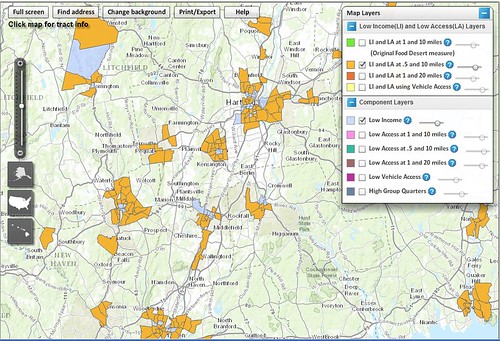
Users of ERS’s Food Access Research Atlas can opt to view low-income census tracts (shaded in gold and in light blue) in a selected area of the country. The gold-shading indicates low-income tracts where a substantial number or portion of residents live at least 0.5 mile from a supermarket in urban areas or at least 10 miles in rural areas. (Central Connecticut) Users of ERS’s Food Access Research Atlas can opt to view low-income census tracts (shaded in gold and in light blue) in a selected area of the country. The gold-shading indicates low-income tracts where a substantial number or portion of residents live at least 0.5 mile from a supermarket in urban areas or at least 10 miles in rural areas. (Central Connecticut)

Access to stores that carry healthy, affordable food can play an important role in people’s nutrition and overall health. Ensuring access to healthy food is a priority for USDA and a key component of First Lady Michelle Obama’s Let’s Move!initiative.
Two years ago, USDA’s Economic Research Service (ERS) first released the Food Desert Locator, an online mapping tool that used the 2000 Census and other data sets to identify low-income census tracts in which a substantial number or share of residents face challenges in accessing the nearest supermarket or large grocery store. My ERS colleagues and I have now updated and expanded the tool and renamed it the Food Access Research Atlas.
The new name better reflects what this tool shows us. Now, the Food Access Research Atlas has updated estimates of food desert census tracts using 2010 census data, and offers several additional distance measures to visualize access to supermarkets. For example, in the original measure, a household was considered to be facing an access challenge if it was more than 1 mile from a supermarket in urban areas of the country or more than 10 miles from a supermarket in rural areas. With the updated Atlas, users can also map low-income and low-access areas using distances of one-half mile and 20 miles.
In addition to expanded data layers for distance, the updated Atlas also highlights the role of vehicle availability in mitigating the difficulties of reaching a supermarket by identifying census tracts where many households lack access to a vehicle. Knowing where people face low access to both supermarkets and vehicles can be a first step toward addressing the most acute access challenges.
Another new feature identifies census tracts where a large proportion of the population lives in dormitories, military quarters, or similar group living arrangements as defined by the Census. While individuals in these census tracts may be far from a supermarket or large grocery store, such facilities frequently provide dining facilities or food stores for their residents. Noting these census tracts may provide a more accurate picture of whether these residents truly experience difficulty accessing affordable and healthy food.
Through these additional measures, updated data, and added layers of detail, the Food Access Research Atlas builds on past research to provide researchers, city planners, non-profit organizations, and policymakers at all levels a more nuanced view of the factors that impact whether people across the country can attain nutritious and varied diets. Check out the Food Access Research Atlas and discover what’s new!

#Privacy Obama and Supremes approve #Warrentless Wiretapping

Sorry Dr. Strangelove You can’t prove that NOT that having your privacy respected by the American Government will harm you.

#Privacy Obama and Supremes approve #Warrentless Wiretapping

Might as well know that it is the exact same thing as living in China.
http://www.allvoices.com/contributed-news/14124172-scotus-approves-warrantless-wiretapping
If you’re worried about the United States government tapping your phone or perusing your emails, don’t complain to the US Supreme Court about it. They don’t want to hear it.
Today, the court ruled that citizens cannot challenge a federal law that allows for warrantless surveillance of international phone calls and emails. The ruling was a blow for civil rights activists and lawyers, and a victory for the Obama administration.
The justices voted 5-4, largely along ideological lines, in favor of the law, which was implemented in 2008. They claimed that the citizens represented by the American Civil Liberties Union-including Amnesty International, lawyers, journalists and international human rights activists-could not sufficiently show that they were actually being harmed by the potential surveillance.

Billboard converts desert air into drinking water

Billboard produces water out of air. According to the university, the billboard produced 9,450 liters of drinking water in three months—enough to sustain hundreds of Peruvian families per month.

Billboard converts desert air into drinking water

Feb 25, 2013

Billboard converts air into water.

An advertising agency has created what it’s calling the world’s first billboard that converts air into drinking water.
The billboard—a collaboration between agency Mayo DraftFCB and Peru’s University of Engineering and Technology—was placed in Peru’s rain-starved desert capital, Lima.
Lima gets less than an inch of rain per year on average, but since the city’s humidity hovers around 98 percent, generators attached to the structure are able to capture atmospheric moisture, filter it and produce potable water.
The harvested water is then stored in 20-liter tanks and can be retrieved from taps at the base of the billboard.
“Agua aqui,” a neon display near the base reads.
According to the university, the billboard produced 9,450 liters of drinking water in three months—enough to sustain hundreds of Peruvian families per month.
 
Watch a short video explaining the project below:
[youtube=http://youtu.be/35yeVwigQcc]