
American Library Association gives #MIT Libraries the middle finger

@CyberPlayGround Loves Librarians who are the best defense for liberty in America.

American Library Association

James Madison Award

About the James Madison Award The award named for President James Madison was established in 1986 and is presented annually on the anniversary of his birth to honor individuals or groups who have championed, protected and promoted public access to government information and the public’s right to know at the national level.

Administered by:

Office of Government Relations logo

2013 Winner(s)

Aaron Swartz @Aaronsw

Before his untimely death in January, Swartz was an outspoken advocate for public participation in government and unrestricted access to peer-reviewed scholarly articles. Swartz was a co-founder of Demand Progress, an advocacy group that organizes people to take action on civil liberties and government reform issues. Swartz was also a leader in the national campaign to prevent the passing of the Stop Online Piracy Act, a bill that would have diminished critical online legal protections.
–//–
MIT Should Make All Its Research Open Access In Honor Of Aaron Swartz
Did MIT kill Aaron Swartz?
Updated Web Tool Maps U.S. Food Access in Greater Detail

Updated Web Tool Maps U.S. Food Access in Greater Detail

Posted by Paula Dutko, Food Assistance Branch, Economic Research Service, on March 11, 2013 at 12:04 PM
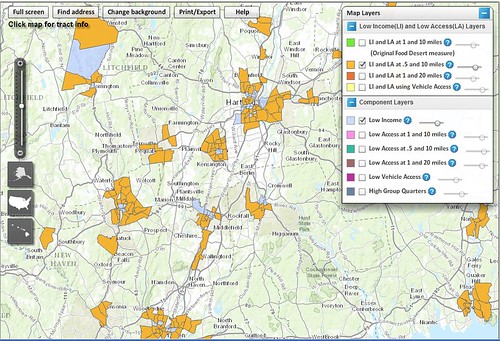
Users of ERS’s Food Access Research Atlas can opt to view low-income census tracts (shaded in gold and in light blue) in a selected area of the country. The gold-shading indicates low-income tracts where a substantial number or portion of residents live at least 0.5 mile from a supermarket in urban areas or at least 10 miles in rural areas. (Central Connecticut) Users of ERS’s Food Access Research Atlas can opt to view low-income census tracts (shaded in gold and in light blue) in a selected area of the country. The gold-shading indicates low-income tracts where a substantial number or portion of residents live at least 0.5 mile from a supermarket in urban areas or at least 10 miles in rural areas. (Central Connecticut)

Access to stores that carry healthy, affordable food can play an important role in people’s nutrition and overall health. Ensuring access to healthy food is a priority for USDA and a key component of First Lady Michelle Obama’s Let’s Move!initiative.
Two years ago, USDA’s Economic Research Service (ERS) first released the Food Desert Locator, an online mapping tool that used the 2000 Census and other data sets to identify low-income census tracts in which a substantial number or share of residents face challenges in accessing the nearest supermarket or large grocery store. My ERS colleagues and I have now updated and expanded the tool and renamed it the Food Access Research Atlas.
The new name better reflects what this tool shows us. Now, the Food Access Research Atlas has updated estimates of food desert census tracts using 2010 census data, and offers several additional distance measures to visualize access to supermarkets. For example, in the original measure, a household was considered to be facing an access challenge if it was more than 1 mile from a supermarket in urban areas of the country or more than 10 miles from a supermarket in rural areas. With the updated Atlas, users can also map low-income and low-access areas using distances of one-half mile and 20 miles.
In addition to expanded data layers for distance, the updated Atlas also highlights the role of vehicle availability in mitigating the difficulties of reaching a supermarket by identifying census tracts where many households lack access to a vehicle. Knowing where people face low access to both supermarkets and vehicles can be a first step toward addressing the most acute access challenges.
Another new feature identifies census tracts where a large proportion of the population lives in dormitories, military quarters, or similar group living arrangements as defined by the Census. While individuals in these census tracts may be far from a supermarket or large grocery store, such facilities frequently provide dining facilities or food stores for their residents. Noting these census tracts may provide a more accurate picture of whether these residents truly experience difficulty accessing affordable and healthy food.
Through these additional measures, updated data, and added layers of detail, the Food Access Research Atlas builds on past research to provide researchers, city planners, non-profit organizations, and policymakers at all levels a more nuanced view of the factors that impact whether people across the country can attain nutritious and varied diets. Check out the Food Access Research Atlas and discover what’s new!

FirstToDisclose.org

a platform for small innovators to post their ideas for the world before a well-heeled enterprise can file a patent on the same idea with the Patent Office in advance March 16, from a “first-to-invent” to a “first-to-file” patent regime.

 FirstToDisclose.org

From: Jonathan Askin <jo************@******aw.edu>
Date: March 15, 2013 5:26:31 PM EDT

A team of Brooklyn Law Incubator & Policy (BLIP) students and I are launching www.firsttodisclose.org

3/15/13 In advance of America’s move tomorrow, March 16, from a “first-to-invent” to a “first-to-file” patent regime).  I thought you might find it blog-worthy or otherwise transmit to your community.  I’ve posted the announcement to the www.BLIPclinic.org blog.

Our objective is to provide a platform for small innovators to post their ideas for the world before a well-heeled enterprise can file a patent on the same idea with the Patent Office.  One consequence of the move from “first to invent” to “first to file” is that it will likely be difficult for small inventors to beat larger enterprises to the patent office with their innovations.  First-to-Disclose is an effort to counterbalance the burden imposed on small inventors.

Info is available at www.firsttodisclose.org

We’ll likely get some minor attention from the patent law community, but I hope the positive ramifications will resonate for years.
Prof. Jonathan Askin
Founder/Director
Brooklyn Law Incubator & Policy Clinic
Brooklyn Law School
One Boerum Place
Third Floor

Brooklyn, NY 11201

Big Food Is Making Us Sick

Food companies shape health legislation and avoid regulation and are making us sick!

Food Corporations makes us sick

Giant Food Corporations Work Hand-In-Glove With Corrupt Government Agencies To Dish Up Cheap, Unhealthy Food

Three companies now account for more than 40 per cent of global coffee sales, eight companies control the supply of cocoa and chocolate, seven control 85 per cent of tea production, five account for 75 per cent of the world banana trade, and the largest six sugar traders account for about two-thirds of world trade, according to the new publication from the Fairtrade Foundation.
 
Reuters notes:
Multinational food, drink and alcohol companies are using strategies similar to those employed by the tobacco industry to undermine public health policies, health experts said on Tuesday.
In an international analysis of involvement by so-called “unhealthy commodity” companies in health policy-making, researchers from Australia, Britain, Brazil and elsewhere said … that through the aggressive marketing of ultra-processed food and drink, multinational companies were now major drivers of the world’s growing epidemic of chronic diseases such as heart disease, cancer and diabetes.
Writing in The Lancet medical journal, the researchers cited industry documents they said revealed how companies seek to shape health legislation and avoid regulation.
This is done by “building financial and institutional relations” with health professionals, non-governmental organizations and health agencies, distorting research findings, and lobbying politicians to oppose health reforms, they said.