ECP NetHappenings TOXIC PERSONAL CARE PRODUCTS AND MAKEUP

❤️️ Sign Up ©2026 NetHappenings News Email List
https://cyberplayground.org
©2026 Follow@CyberPlayGround
©1998-©2026 *Educational CyberPlayGround®
©2026 https://k12playground.com
©2026 https://RichAsHell.com
©1993 – ©2026 https://edu-cyberpg.com

Hi Everyone,
I’ve been meaning to send this out for days now.
We all have to check our soap, lotions, and makeup.
Throw out everything that isn’t good for us and buy what is.


TOXIC PERSONAL CARE PRODUCTS AND MAKEUP

“Personal care products and cosmetics should be non-toxic for everyone,” Friedman said in a news release https://www.ewg.org/news-insights/news-release/2023/10/cosmetics-safety-milestone-california-gov-newsom-approves-ban-26) from the Environmental Working Group, a nonprofit environmental health organization that sponsored the legislation. Banned ingredients — including vinyl acetate, boron substances, certain colors and styrene — are found in at least hundreds of products, according to the Environmental Working Group.
You can view the list of all 50 banned chemicals here (https://leginfo.legislature.ca.gov/faces/billTextClient.xhtml?bill_id=202320240AB496).

Your guide to safer personal care products (https://www.ewg.org/skindeep/)

xoxoxoxox

Educational CyberPlayGround

▓▓▓—▓▓▓—▓▓▓

ECP NetHappenings Freedom of the Press

❤️️ Sign Up ©2026 NetHappenings News Email List
https://cyberplayground.org
©2026 Follow@CyberPlayGround
©1998-©2026 *Educational CyberPlayGround®
©2026 https://k12playground.com
©2026 https://RichAsHell.com
©1993 – ©2026 https://edu-cyberpg.com

The Center for Media and Democracy is a national watchdog group that investigates corruption that undermines our democracy, environment, and economic prosperity

JOURNALISTS AND REPORTERS

LINKProPublica and The Connecticut Mirror Win Pulitzer Prize for Local Reporting
The award, for uncovering predatory state towing practices, marks ProPublica’s 9th Pulitzer; two additional investigations were named finalists.

LINK“Five major publishers — Hachette, Macmillan, McGraw Hill, Elsevier and Cengage — and the best-selling novelist Scott Turow have filed a class-action copyright infringement lawsuit against Meta and its founder and chief executive, Mark Zuckerberg.”
AI is built on a foundation of rampant and uncontrolled theft. It’s a criminal enterprise feigning legitimacy.
“The lawsuit filed on Tuesday against Meta brought together trade and education publishers, academic publishers of scientific and medical journals and a best-selling author of legal thrillers.
The plaintiffs are seeking an order requiring Meta to destroy all illegally acquired”

LINKEvan DeSimone @MediaEvan
Almost all of these news influencers build their brand by commenting on reporting done by real journalists at legacy outlets.
Bravo to @hannah_natanson, whose Pulitzer Prize reporting overcame an outrageous and chilling FBI raid on her home, a threat to journalism in this country.
Trump’s FBI kicked in her door.
Took her phones. Took her laptops. Took everything.
Hannah Natanson just took a Pulitzer Prize.
You cannot intimidate the truth out of a journalist.
You just make them more dangerous.

LINKSince January 2025, the Trump admin has consistently targeted journalists for their reporting.
Ahead of World Press Freedom Day, we’re urging the DOJ to drop charges against @ByGeorgiaFort and other journalists. https://www.amnestyusa.org/blog/civil-society-organizations-urge-doj-to-drop-charges-against-georgia-fort-and-other-members-of-the-press/

CREATORS, INFLUENCERS, AGGREGATORS

A new report shows that social media ‘influencers’ and ‘independent creators’ are taking a greater role in providing news to Americans – especially younger Americans.
https://www.usnews.com/news/national-news/articles/2026-05-01/social-media-closing-in-on-tv-as-americans-choice-for-news
They’re not journalists or creators, they’re aggregators, retweeting isn’t actual journalism. Aggregating* news to Americans is still very important to take note of! But has a different implication than being an actual journalist.

THE CREATOR ECONOMY
68% of creators say brand deals are their main income. So, influencers are the new journalists… if journalism was a side gig for selling skincare.
Who knew truth could come with a promo code?
https://www.emarketer.com/content/creator-economy-revenues-forecast-2024

LINKA $787 MILLION settlement from FOX News for LYING to their viewers on air. REPEATEDLY
And they’re still doing it!
Governor Newsom has a defamation lawsuit against them right now!

EXCLUSIVE: Behind the scenes, the Trump administration has been wielding its vast power to transform the midterm elections.
This is the untold story of Trump’s efforts to, as he has called it, “take over” the midterms.
https://www.propublica.org/article/trump-midterm-elections-takeover

THE TIMELINE
April 28: All 6 conservative justices— John Roberts, Clarence Thomas, Samuel Alito, Neil Gorsuch, Brett Kavanaugh, and Amy Coney Barrett— showed up to a white-tie dinner at the White House honoring King Charles.
Next morning: The Voting Rights Act was gutted in a 6-3 decision.
Same six. Same vote.

Howard Lucknick scheduled to testify tomorrow about his relationship with Jeffrey Epstein, and reportedly also about his efforts in DC on behalf of @Tether syndicate boss Giancarlo Devasini.
https://www.pbs.org/newshour/politics/who-is-howard-lutnick-and-whats-his-connection-to-jeffrey-epstein

We found the secret “Jeffrey E. Epstein Fund for Women’s Athletics.”
It opened a new rabbit hole into how the billionaire pedophile used Harvard to launder his image. And why the world’s richest university whitewashed its own Epstein investigation.

Trump & Republicans slashed Medicaid, gutted SNAP, and starved working families — then handed $200 BILLION to the Pentagon for endless war.

The Ohio primaries are today… Democrats are now projected to win the Governor election.

LINKRay Kurzweil wrote his first computer program in 1963. 1963. He was 15 years old. Has made over 100 predictions about computers decades ago that came true. Yes, our phones are not secure Google has the capabilities to make it so. It’s just not for us plebes. Kurzweil is an author who popularized tech singularity in his work, and he is resurfacing in the “golden age of AI” where dooming about chatbots is the next level of marketing.

Graham Platner for Senate @grahamformaine
Nobody works hard enough to justify being a billionaire.

My name is Graham Platner and I’m running for US Senate to defeat Susan Collins and topple the oligarchy that’s destroying our country. I’m a veteran, oysterman, and working class Mainer who’s seen this state become unlivable for working people. And that makes me deeply angry.


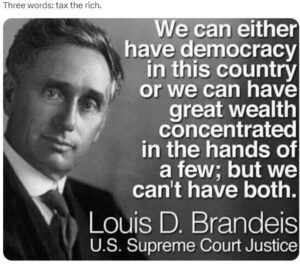
Jeff Bezos, who paid $10 million for the Met Gala, got $62 billion richer since Trump was elected & spent $500 million on a yacht to sail to his $55 million wedding in Venice to give his wife a $5 million ring because his tax rate is less than 1%. 4 words: Tax the damn rich.

Sen. Bernie Sanders @SenSanders
The reality of American life today: Jeff Bezos, worth $290 billion, spent:
$10 million on the Met Gala
$120 million on a penthouse
$500 million on a yacht
Meanwhile, he‘s planning to throw 600,000 Amazon workers out on the streets and replace them with robots.
Unacceptable.

Rep. Joe Neguse @RepJoeNeguse
My resolution proposing a constitutional amendment to overturn the Supreme Court’s Citizens United decision now has 79 co-sponsors.
You can view the full list at: https://congress.gov/bill/119th-congress/house-joint-resolution/122.
I’ll keep fighting to get it across the finish line!

FireFighterDev @fire_starter457
I’m going to be honest, the last 4 times I’ve filled up my gas tank, I thought about many things. None of those things were sharing a bathroom with a trans person, a mom buying soda with her SNAP or whether the guy in front of me in line was documented.

“Deutsche Bank denies training bankers to manipulate markets”
Convicted former precious metals trader James Vorley is suing Deutsche Bank for about $16 million.
He says the bank trained him to illegally spoof to manipulate markets.
The bank says it didn’t. https://www.ft.com/content/c959dbe1-eb96-414d-adcf-5f17330a195b
Vorley served a year in prison after being convicted in 2021

FTC to ban data broker Kochava from selling Americans’ location data

KEN GRIFFIN DESTROYS SPIRIT AIRLINES
@GovRonDeSantis Ken Griffin your largest individual DONER has destroyed the Florida based Spirit Airlines. 17 THOUSAND JOBS LOST
He is not a philanthropist he is a FINANCIAL TERRORIST.
THIS IS A TRAGEDY CAUSED BY PRIVATE CREDIT KEN GRIFFIN CITADEL SECURITIES

Jeffery Epstein’s butler was caught in an FBI sting in 2009 trying to sell the client & victim list.
He told them the entire operation, 17 years ago.
And the FBI did NOTHING. Actually, the FBI arrested the Butler who was exposing Epstein’s crimes instead of Epstein… fascinating, huh? he spent several years in prison as a result.
video https://x.com/PastorBobJ67896/status/2051279484364497111

▓▓▓—▓▓▓—▓▓▓

ECP NetHappenings Elon Musk’s xAI breaking its promise to MEMPHIS

❤️️ Sign Up ©2026 NetHappenings News Email List
https://cyberplayground.org
©2026 Follow@CyberPlayGround
©1998-©2026 *Educational CyberPlayGround®
©2026 https://k12playground.com
©2026 https://RichAsHell.com
©1993 – ©2026 https://edu-cyberpg.com

Oh look — @politico is covering Elon Musk’s xAI breaking its promise to MEMPHIS to build a water recycling plant, and says they’re not responding to questions. @SenBrentTaylor

Musk promised his data center would reuse water. That’s now stalled.
Elon Musk’s artificial intelligence company abruptly stopped work on a water reuse facility meant to alleviate strain on the Memphis-area water supply. Nobody’s saying why.
https://www.politico.com/news/2026/05/05/xai-water-reuse-project-musk-ai-spacex-ipo-environmental-project-ee-00896170

This Fucking Nazi

ESSAY

Ricardo @Ric_RTP
OpenAI just created a $10 billion company whose ONLY job is forcing businesses to use AI.

And they’re literally guaranteeing investors a 17.5% annual return to make it happen.

It’s called “The Deployment Company.” OpenAI finalized it yesterday with 19 investors including TPG, SoftBank, Bain Capital, Brookfield, and Advent International.

Here’s the structure:

OpenAI puts in $1.5 billion. The private equity firms put in $4 billion.

In exchange, those PE firms open up their 2,000+ portfolio companies as a CAPTIVE customer base for OpenAI’s products.

OpenAI then embeds teams of engineers directly inside those companies, Palantir-style, to integrate their tools into daily operations.

And here’s the big red flag in all of this:

OpenAI is GUARANTEEING those PE firms a 17.5% annual return over five years.

That means even if the companies in the portfolio don’t want AI, don’t need AI, or get zero value from AI, OpenAI is still on the hook to pay those returns.

Think about what that means for a second.

OpenAI is so desperate for enterprise adoption that they’re paying Wall Street to force their product into thousands of businesses. They’ve essentially turned private equity firms into a distribution cartel with a guaranteed commission.

This has NEVER been done before in enterprise software.

No software company in history has guaranteed above-market returns to financial sponsors just to get their product installed.

And it gets crazier:

Within MINUTES of OpenAI’s announcement, Anthropic announced their own version.

A $1.5 billion joint venture with Blackstone, Goldman Sachs, and Hellman & Friedman.

Same playbook.

Two companies worth a combined $1+ TRILLION in private valuation both concluded on the same day that organic demand for their products is not growing fast enough.

If enterprises were lining up to buy AI on their own, you wouldn’t need to bribe private equity firms with guaranteed returns to shove it into their portfolios. You would just sell it normally like every other software company in history.

But they can’t. Because the gap between what AI companies PROMISE and what enterprises actually experience is still enormous.

OpenAI’s COO Brad Lightcap just moved into a new role specifically to lead this push. They’ve also signed “Frontier Alliances” with major consulting firms to embed AI through professional services channels. Every move they’re making screams the same thing:

We have a demand problem.

And this is all happening right before OpenAI tries to IPO at $850 billion.

If they can show Wall Street that 2,000+ companies are “using OpenAI products” through this PE distribution channel, it inflates their enterprise metrics right before the roadshow.

Doesn’t matter if those companies actually need it or if it creates real value. What matters is the number on the S-1.

This is the AI playbook entering its most dangerous phase.

The tech is real but the business model is being held together by financial engineering, guaranteed returns, and captive distribution deals that look more like a pharmaceutical company paying doctors to prescribe their drug than a software company earning customers on merit.

And both OpenAI and Anthropic admitted it on the same day.

ECP NetHappenings Quantum Fear-Mongering and The Infinite Perils Trap

❤️️ Sign Up ©2026 NetHappenings News Email List
https://cyberplayground.org
©2026 Follow@CyberPlayGround
©1998-©2026 *Educational CyberPlayGround®
©2026 https://k12playground.com
©2026 https://RichAsHell.com
©1993 – ©2026 https://edu-cyberpg.com

ESSAY
@Cory 🦢 Real Bitcoin @ Swan.com
@CorySwan
https://x.com/CorySwan/status/2051365653530157230

Re Quantum and Bitcoin:
The risks that justify extreme precaution are not merely the ones that sound scary.
They are the ones that are connected and scalable.
Connected means the threat spreads through the system.
Scalable means a small failure can cascade into ruin for everyone.

LINKQuantum Fear-Mongering and The Infinite Perils Trap

Alex Thorn @intangiblecoins had a strong post on quantum and Bitcoin coming out of the Vegas discussions this week. I agree with most of it, and I think there’s a broader risk framework that explains why the emerging middle ground is the right one.

The quantum debate keeps skipping the most important question.

Not “is quantum a risk?”

Of course it is.

The question is what kind of risk it is.

That distinction matters because of a fallacy that shows up in almost every tail-risk debate:

The Infinite Perils Trap.

If a risk sounds catastrophic enough, people start treating any non-zero probability as justification for emergency intervention.

That sounds serious. It is often just sloppy.

There are infinite potential perils. Quantum. AI. Asteroids. Engineered pandemics. State attacks. Supply chain attacks. Unknown unknowns.

You cannot spend 50% of the attention budget on each one.

At some point “prudence” becomes resource exhaustion.

This is where Nassim Taleb’s systemic-risk filter is useful.

The irony is that Taleb is often invoked to justify maximal precaution, but his framework also tells you when NOT to go all-in. The risks that justify extreme precaution are not merely the ones that sound scary. They are the ones that are connected and scalable.

Connected means the threat spreads through the system.

Scalable means a small failure can cascade into ruin for everyone.

Pandemics qualify. Banking contagion qualifies. Highly levered financial systems qualify.

A car crash does not. A restaurant failure does not. An airline bankruptcy usually does not.

Different risk category, different response.

Now apply that to quantum and Bitcoin.

Quantum is not systemic. It is idiosyncratic.

It fails on scalability.

The attack surface is address-by-address. There is no magic “break Bitcoin” button. Cracking one exposed public key does not mechanically crack the next one. It does not trigger a cascade across the UTXO set. The attacker has to do the work for every address he wants to attack.

Satoshi’s coins are the cleanest example. People talk about them as if they are one giant honeypot. They are not. They are spread across roughly 22,000 separate P2PK addresses, usually 50 BTC each.

A long-range attack would have to go address by address. That is a very different risk profile from “one person can take Satoshi’s million coins.”

Quantum also fails on connectivity.

A successful crack of an old, long-cold address does not infect other addresses. It does not corrupt consensus. It does not rewrite the ledger. It does not change the 21 million cap. It does not cause other private keys to fall like dominos.

The attacker gets access to specific vulnerable coins.

That may be painful. It may be ugly. It may cause a violent repricing.

But painful is not the same as systemic.

This is also why the “giant honeypot” framing needs precision.

The real concentrated targets are exchanges, ETFs, custodians, and other active entities. ETF holders themselves cannot rotate addresses, but the custodians controlling the actual coins can. Same with exchanges. Same with large active treasury holders. If the threat becomes real enough, those entities can move to post-quantum addresses.

Satoshi’s coins are different because they are dormant. But even there, the risk is far more distributed than the panic narrative suggests.

Roughly 22,000 addresses, not one vault.

And this is where the fallacy matters.

Once you misclassify an idiosyncratic risk as systemic, you start justifying interventions that create real systemic risk.

Freeze Satoshi’s coins.

Invalidate old addresses.

Rush immature cryptography into consensus.

Force a panic fork.

Create gridlock around every other upgrade.

Turn every theoretical threat into a political emergency.

That is where the systemic risk actually lives.

The intervention scales.

The intervention connects.

The intervention changes the property-rights model.

Bitcoin can survive old coins moving. It cannot survive the normalization of “these coins make us nervous, therefore we can touch them.”

That precedent would propagate everywhere.

Lost coins.

Dormant coins.

Sanctioned coins.

Coins from old hacks.

Coins held by unpopular people.

Coins held by political enemies.

Coins that some future coalition decides are dangerous.

That is connectivity.

That is scalability.

That is systemic.

The cure becomes the contagion.

This is why “don’t touch Satoshi’s coins” is not sentimental. It is the rigorous answer.

Property rights are not downstream of convenience. They are the product.

Bitcoin does not promise that every old cryptographic choice will remain optimal forever. It promises that valid coins remain valid coins, and that nobody gets to rewrite the rules because a future committee got scared.

The market absorption point is secondary, but still important.

Even in a nightmare scenario where very old coins moved, that is a market event, not a protocol death. Data from
@Checkmatey
and others shows Bitcoin absorbing 1M+ BTC of movement since October 2025 alone.

A massive supply shock would hurt.

It would not require us to violate property rights to survive.

That is the point.

None of this means “ignore quantum.” It means classify the threat properly.

Working on post-quantum cryptography, testing schemes, compressing signatures, debating implementation paths, funding serious work, and having credible options on the shelf are all good things.

The middle ground seems basically right:

Do the work.

Prepare contingencies to have on the shelf if needed.

Do not rush the protocol.

Do not touch Satoshi’s coins.

Quantum is worth working on even if it remains a low-probability tail risk. But a low-probability tail risk is not a license to break Bitcoin’s deepest norms.

That is the Infinite Perils Trap.

If every scary non-zero risk becomes a protocol emergency, Bitcoin stops being conservative money and becomes a committee-managed anxiety machine.

The right response is not complacency, it is proportionality.

Quantum is a real research problem, but it is not a reason to freeze coins.

Prepare seriously.

Move slowly.

Preserve the rules.

Leave Satoshi’s coins alone.

▓▓▓—▓▓▓—▓▓▓