
Youtube.com ~ Culture Keeper
Harry in Your Pocket 1973 movie

The old school grifter pick pockets discuss the art of the game and where money is headed, and complains how the game is getting harder because people don’t carry the same amount of cash around anymore.
James Coburn’s character explains that cash will go away because
– It is inevitable –
that credit cards and computers have made everything electronic.
The old school Grifter objects! because Communism . . . .
Nobody was thinking of Bitcoin in 1973. The Future is Now.
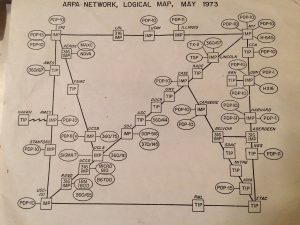 I found this 1973 MAP
OF THE INTERNET
94 Year old knew all about Green Stamps and bought One Thousand dollars of bitcoin in 2015
The Father of Bitcoin Found Living in California
Crypto Regulation Fraud versus Regulated Bankers Fraud
DAVOS 1% Swiss Bank SEBA Bank AG offers crypto
Kids in elementary school will never know a world without digital currencies.

Another 1973 Map of the Entire Internet
Going through old papers my dad gave me, I found his map of the internet as of May 1973.
The entire internet. pic.twitter.com/0krvYoRGav
— David Newbury (@workergnome) December 10, 2016
Back in the 1970s, David Newbury’s dad, Paul, worked at Carnegie Mellon, one of the leading computer science schools in the country. This was in the very early years of the Internet, back when it was the secret and very small ARPANET, which had started in the late ’60s, with just four locations. By 1973, it had expanded to a small handful of government labs, research universities, and private companies—but still so few that the entire network could be mapped on a single sheet of paper.
Recently, Newbury found that map among his dad’s papers and posted it online. You can find Stanford, UCLA, Utah and UCSB, the original members, but by 1973, ARPANET had expanded east, to Case Western, Carnegie Mellon, Harvard, and MIT. There are government labs, like Lawrence Berkeley National Lab and the Army’s Aberdeen Ballistic Research Lab, and private research organizations like MITRE and Xerox. <snip>
More – k12playground.com internet history
GLEASON SACKMANN INTERNET PIONEER
Rated #10 on Newsweek’s prestigious List of “50 People Who Matter Most on the Internet.” ~ Newsweek Dec 25, 1995 / Jan. 1, 1996
Learn about K12 Internet Pioneer Gleason Sackman’s 1996 collected the first text file of K12 websites ever made that appeared on the internet.
The Educational CyberPlayGround, Inc. built, and hosted the database for the public folklife project built by the nation. Over 100,000 school websites including the first one.
GLEASON SACKMANN FIRST TO WIRE NORTH DAKOTA’S K-16 SCHOOLS TO THE INTERNET
1998 Sackman received the SIG/Tel Educational Telecomputing Outstanding Service Award.