
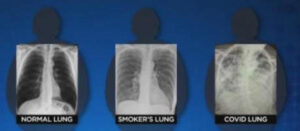
NORMAL LUNG
SMOKERS LUNG
COVID LUNG
This virus is not just a fleeting illness; it has long-term implications that are now unfolding before us.
I’ve seen numerous sources stating that we should be cautious about the term ‘mild’; that is important as people have been led to believe the pathogen is nothing more than something similar to an upper respiratory infection that can be shrugged off.
HARVARD CORONAVIRUS RESOURCE CENTER
@yaneerbaryam
Well over 100 scientific articles describe immune system damage caused by COVID. This provides a direct causal scientific explanation of unprecedented outbreaks of many other diseases.
The “normalization” narrative is casting around for speculative explanations. Ignore them.
For discussions of the impact of COVID on the immune system, please read this COVID-19 and Immune Dysregulation, a Summary and Resource
Great resource. Long COVID may not only be a persistent viral infection but may also be aging immune cells.
— 70% of household Covid transmission starts with a child. School-age children have always been viral incubators of plague and that’s only gotten worse since Covid.
Dr. Sean Mullen
@drseanmullen
There’s a critical aspect of SARS-CoV-2 infection that many still don’t grasp. This virus has a way of affecting us all differently, but one thing is increasingly clear: children are alarmingly MORE susceptible to airborne pathogens like TB, RSV, and pneumonia. The reason? Their school environment encapsulates and forces sharing of air filled with biologically hazardous pathogens, and their immune systems are still developing, making them more vulnerable to such infections.
Moreover, there’s growing evidence of cognitive impairment in children post-COVID. This is deeply concerning, yet it’s been completely overshadowed by nostalgia for normalcy and the dangerous idea that ‘learning loss’ from lost proximity to human bodies is more of a priority than ‘brain cells lost’ to infection. The assumption that a temporary switch to remote education was more harmful than exposing children to a virus that can impair their cognitive abilities was a tragic miscalculation.
Adults, on the other hand, while they may be more reluctant to admit it, are experiencing cognitive declines too. And they’re facing different battles – vascular issues, endocrine irregularities, digestive problems, and potentially an increased susceptibility to fungal infections. These are not just abstract risks; they are the direct consequences of repeated COVID-19 infections.
What’s frustrating is that these outcomes are preventable. Yet, there seems to be a lack of will to initiate change. The former Surgeon General
@JeromeAdamsMD’s words resonate deeply here: We are indeed facing an ‘immune deficit’, not from a lack of exposure to various pathogens, but from an overwhelming exposure to one particular virus.
This virus is not just a fleeting illness; it has long-term implications that are now unfolding before us. The choices made, driven by certain groups and the desire for normalcy, have led us to this point. It’s vital we understand this, not to dwell on the past, but to make informed choices for our future.