
 POV POINT OF VIEW
THANK YOU SATOSHI WHOEVER YOU ARE
This is only the beginning. We are in the Age of Digital Finance, where money and software is native to the internet.
This is the single most important event in the history of money and humanity. It is optimism for everyone. Crypto redefines money and information, the two fundamental ways the world coordinates.
 Think of Satoshi’s White paper and Bitcoin as a startup.
The public includes anyone who learned about investing in bitcoin. Citizens around the world invested. People hoped to make bitcoin become accepted as something real – viable currency – store of value. For the past 12 years they endured having the startup go down and pronounced dead then watch it come back to life many, many times. This was a struggle for normal people, and a normal struggle that every startup expects to goes through.
Think of these normal people as investors who had to believe in something. They believed this bitcoin was a way to change the world and make it better for mankind. This is exactly what they believed when they released the internet also. Satoshi’s white paper came after the 2008 world collapsed because of the disgusting bankers and politicians. This idea could free everyone from a manipulated market where everything always crashed and only the .01% untouchable made more money while never paying taxes.
The lone voice versus all the smart people across the table.
Think of all the years the normies told their friends and family about the opportunity they had to make the world a better place, if they just bought bitcoin. And then be told “no” – they would never do it- that it was garbage, a stupid scheme, con job, and that the law will come and shut it down. It would never be worth anything.
These initial normies, the investors, who managed to stay in the fight and endure the pressure of losing all their money happened over and over again through the years. Bitcoin never died.
Ironically, the smart money is only getting in now cause that wasn’t legal for them to invest in the first place. Isn’t that funny? Only the hoi polloi decided to buy bitcoin. Now all the “smart” money knows if crypto isn’t in their treasury the value of $$$$ USD puts them at risk, so they have to buy it!
This is a very good result. This is the opportunity of lifetime. This is transformational wealth and we get to watch life change for everyday people who in the beginning had a good heart and wanted the internet to make the world a better place. ~ Amen
It’s like 1994 all over again. It is THAT exciting!!!!
From the Hippies in the 60’s who envisioned the internet and tried to make knowledge / information be free that created a blockchain financial platform that used the power of 1’s and 0’s to free the digital energy changed humanity.
Coinbase is unlike any market debut Wall Street has ever seen.
The Industrial Age
The money of humanity in the industrial age was gold, silver, stocks and bonds artifacts left over from Monarchy, Colonialism, Piracy and War.
 The Internet is born
the first domains
 The Digital Age
The The Dot.Com Era
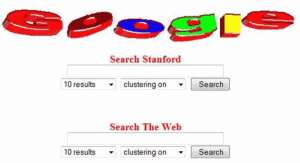
Goggle 1997
May 15, 1997 Amazon an online bookstore held it’s IPO. It was valued at $438 million. In 2017 it was the fourth largest public company in the United States with an annual revenue that exceeds $150 billion.
The Information Age
Where the digitization of money built for the internet changes humanity forever.
CryptoEconomy is Born
Bitcoin is 12 years old. Coinbase, was founded in 2012 has preliminary results for the first quarter of 2021, with revenue surging to US$1.8 billion. The IPO will trade under the ticker COIN and list 114,850,769 shares on the NASDAQ with an initial valuation of US $100 billion.
Coinbase’s rich valuation is tied to bitcoin and ethereum prices.
The long-term value of the company goes way beyond those two currencies and will come from a shift in the structure of finance and online marketplaces.
Coinbase Global Inc COIN:NASDAQ
https://www.cnbc.com/quotes/COIN
Coinbase Global, Inc. is a financial technology company that provides end-to-end financial infrastructure and technology. It is primarily focused in building cryptoeconomy, a transparent financial system enabled by crypto that leverages crypto assets, a digital asset that is build using blockchain technology. Its platform enables approximately 43 million retail users, 7,000 institutions, and 115,000 ecosystem partners in over 100 countries to participate in the cryptoeconomy.
C/O The Corporation Trust Company
1209 Orange Street
Wilmington, DE
19801 United States
Coinbase Current estimate
Coinbase shares will now open at $340, not $250 like widely expected. The last time “I” remember an IPO disparity this big was Amazon. If you had invested $10K in Amazon back then, you would have around $29 million today.
[was] Coinbase gets reference price of $250 per share from Nasdaq ahead of today’s direct listing
Nasdaq gave Coinbase a reference price of $250 a share ahead of Wednesday’s planned direct listing, which would value the cryptocurrency exchange at about $65.3 billion on a fully diluted basis.
Currently —-> $COIN Coinbase Global, Inc. $337.28 3:20 pm 4/14/21 https://www.nasdaq.com/market-activity/stocks/coin
Coinbase is set to become the first major crypto business to go public in the U.S. and, should it reach a $100 billion market cap, will instantly be one of the country’s 85 most valuable companies. The company’s value has soared in the past year alongside bitcoin and ethereum, the primary currencies traded on the site.
Bitcoin Price Prediction: Why Bitcoin Could Rocket To $400,000 In 2021 ~ Forbes
Would you still think you were too late to buy #Bitcoin if you read that it was going to $1 million over the coming years?
Perspective “trickle-down economics”
Stock Market crashed 1929, 1987, 1992, 1997, 2000, 2007-08,
1997 Bernie Madoff was the perpetrator of the largest Ponzi scheme in history. He cheated clients out of billions of dollars.
2007-8
TARP, the federal government rescued hobbled financial institutions; it also assumed control of other agencies, like troubled mortgage-market-makers Fannie Mae and Freddie Mac. The Dodd-Frank Wall Street Reform and Consumer Protection Act of 2010 regulated swaps and other exotic investments for the first time and led to the creation of the Consumer Financial Protection Bureau.
THE BANKERS AND POLITICIANS HAVE ROLLED BACK & OVERTURNED ALL THE CONSUMER PROTECTION LAWS THAT WERE PUT IN PLACE BACK THEN.
2008 SATOSHI WHITE PAPER RELEASED
The COVID-19 Crash of 2020
 The definition of inflation – has nothing to do with what THE BIS, IWF, Yellen, Powell or any politician tells you.
You know what inflation is when you have to buy food, buy energy, buy a house or a car. We know what inflation means.
Goldman Sachs CEO David Solomon on CNBC calls for Bitcoin to surpass gold market cap. “I think Bitcoin is on an inevitable path to have the same market capitalization and then a higher one than gold. It’s how fast adoption is happening. Adoption is happening faster than I had predicted.”
#FOMO = FEAR OF MISSING OUT #BITCOIN
PAPA’S GOT A BRAND NEW BAG
Love,
ECP
The philosophy behind Bitcoin traces to the earliest days of the open internet. Articulated in John Perry Barlow’s 1996 Declaration of the Independence of Cyberspace,
https://www.eff.org/cyberspace-independence
it was and is the ethos of tech startups: Code is more trustworthy than institutions. Information is meant to be free, and nobody has the right — and should not have the ability — to control it.
But information must reside somewhere. Code is written by and for people, stored on computers located within countries, and embedded within the institutions and societies we have created. To trust information is to trust its chain of custody
https://zeynep.substack.com/p/the-pandemic-heroes-who-gave-us-the
and the social context
https://zeynep.substack.com/p/lessons-from-a-pandemic-anniversary
it comes from.
https://zeynep.substack.com/p/critical-thinking-isnt-just-a-process
Neither code nor information is value-neutral, nor ever free of human context.
Today, Barlow’s vision is a mere shadow; every society controls the information its people can access. Some of this control is through overt censorship, as China controls information about Taiwan, Tiananmen Square, and the Uyghurs. Some of this is through civil laws designed by the powerful for their benefit, as with Disney and US copyright law, or UK libel law.
Bitcoin and blockchains like it are on a collision course with these laws. What happens when the interests of the powerful, with the law on their side, are pitted against an open blockchain? Let’s imagine how our various scenarios might play out.
China first: In response to Falun Gong texts in the blockchain, the People’s Republic decrees that any miners processing blocks with banned content will be taken offline — their IPs will be blacklisted. This causes a hard fork of the blockchain at the point just before the banned content. China might do this under the guise of a “patriotic” messaging campaign, publicly stating that it’s merely maintaining financial sovereignty from Western banks. Then it uses paid influencers and moderators on social media to pump the China Bitcoin fork, through both partisan comments and transactions. Two distinct forks would soon emerge, one behind China’s Great Firewall and one outside. Other countries with similar governmental and media ecosystems — Russia, Singapore, Myanmar — might consider following suit, creating multiple national Bitcoin forks. These would operate independently, under mandates to censor unacceptable transactions from then on.
Disney’s approach would play out differently. Imagine the company announces it will sue any ISP that hosts copyrighted content, starting with networks hosting the biggest miners. (Disney has sued to enforce its intellectual property rights in China before.) After some legal pressure, the networks cut the miners off. The miners reestablish themselves on another network, but Disney keeps the pressure on. Eventually miners get pushed further and further off of mainstream network providers, and resort to tunneling their traffic through an anonymity service like Tor. That causes a major slowdown in the already slow (because of the mathematics) Bitcoin network. Disney might issue takedown requests for Tor exit nodes, causing the network to slow to a crawl. It could persist like this for a long time without a fork. Or the slowdown could cause people to jump ship, either by forking Bitcoin or switching to another cryptocurrency without the copyrighted content.
And then there’s illegal pornographic content and leaked classified data. These have been on the Bitcoin blockchain for over five years, and nothing has been done about it. Just like the botnet example, it may be that these do not threaten existing power structures enough to warrant takedowns. This could easily change if Bitcoin becomes a popular way to share child sexual abuse material. Simply having these illegal images on your hard drive is a felony, which could have significant repercussions for anyone involved in Bitcoin.
Whichever scenario plays out, this may be the Achilles heel of Bitcoin as a global currency.
If an open network such as a blockchain were threatened by a powerful organization — China’s censors, Disney’s lawyers, or the FBI trying to take down a more dangerous botnet — it could fragment into multiple networks. That’s not just a nuisance, but an existential risk to Bitcoin.
Suppose Bitcoin were fragmented into 10 smaller blockchains, perhaps by geography: one in China, another in the US, and so on. These fragments might retain their original users, and by ordinary logic, nothing would have changed. But Metcalfe’s law implies that the overall value of these blockchain fragments combined would be a mere tenth of the original. That is because the value of an open network relates to how many others you can communicate with — and, in a blockchain, transact with. Since the security of bitcoin currency is achieved through expensive computations, fragmented blockchains are also easier to attack in a conventional manner — through a 51 percent attack — by an organized attacker. This is especially the case if the smaller blockchains all use the same hash function, as they would here.
Traditional currencies are generally not vulnerable to these sorts of asymmetric threats. There are no viable small-scale attacks against the US dollar, or almost any other fiat currency. The institutions and beliefs that give money its value are deep-seated, despite instances of currency hyperinflation.
The only notable attacks against fiat currencies are in the form of counterfeiting. Even in the past, when counterfeit bills were common, attacks could be thwarted. Counterfeiters require specialized equipment and are vulnerable to law enforcement discovery and arrest. Furthermore, most money today — even if it’s nominally in a fiat currency — doesn’t exist in paper form.
Bitcoin attracted a following for its openness and immunity from government control. Its goal is to create a world that replaces cultural power with cryptographic power: verification in code, not trust in people. But there is no such world. And today, that feature is a vulnerability. We really don’t know what will happen when the human systems of trust come into conflict with the trustless verification that make blockchain currencies unique. Just last week we saw this exact attack on smaller blockchains — not Bitcoin yet. We are watching a public socio-technical experiment in the making, and we will witness its success or failure in the not-too-distant future.
This essay was written with Barath Raghavan, and previously appeared on Wired.com.
https://www.wired.com/story/opinion-bitcoins-greatest-feature-is-also-its-existential-threat/
EDITED TO ADD (4/14): A research paper on erasing data from Bitcoin blockchain.
GOOD CHOICES: President Biden announced key cybersecurity leadership nominations Monday, proposing Jen Easterly as the next head of the Cybersecurity and Infrastructure Security Agency and John “Chris” Inglis as the first ever national cyber director (NCD).
In terms of adoption, Bitcoin has roughly the same users as the Internet had in 1997. But Bitcoin’s growing faster. Next 4 years on current path will bring Bitcoin users to 1b people, that’s the equivalent of 2005 for the Internet.
The U.S. Senate has confirmed the new SEC Chairman, Gary Gensler. Gary Gensler is a professor at MIT who taught a blockchain course that included a reading of the #Bitcoin
Whitepaper.
He will rule on allowing ETFs And xrp
Coinbase ‘IPO’ Isn’t an IPO. Here’s Why That’s Important
https://finance.yahoo.com/news/coinbase-ipo-isn-t-ipo-170515491.html