
Apparently FDIC provides unlimited coverage now which must be exciting for the 1%.
FDIC insurance now covers all deposits…. Let the good times roll. Only people losing are those who own stock/equity in bank- that’s all gone.
#Bitcoin is safe, Banks Aren’t
#Bitcoin Up 15% While Banks are Failing
All Roads Lead to Bitcoin
Proof of Work = Proof of Power
Here’s What’s Happening
It’s amazing how quickly libertarians & free market capitalists become socialists when they’re faced with the logical consequences of their deregulated actions.
The Silent March of Bitcoin Policies Across US States
Because it separates state from money, Bitcoin is inherently a political animal.
BAILOUTS
Silicon Valley Bank Bailout Ruled Out By Treasury Secretary Janet Yellen
Treasury Secretary Janet Yellen said Sunday that the federal government is not considering a bailout for Silicon Valley Bank, but is focused on addressing the needs of the failed bank’s depositors.
During an interview CBS’ “Face the Nation,” Yellen drew a distinction between how the current situation surrounding Silicon Valley Bank would be handled compared to the global financial crisis that led to historic bank bailouts 15 years ago.
“We’re not going to do that again,” Yellen said in reference to a potential bailout. “But we are concerned about depositors and are focused on trying to meet their needs.”
After Silicon Valley Bank was closed by California banking regulators on Friday, its operations were overtaken by the Federal Deposit Insurance Corporation (FDIC), which insures member bank deposits of up to $250,000.
Among the 20 largest commercial banks in the U.S., the bank had $209 billion in assets under management and around $175 billion in deposits by the end of last year. As the bank’s reopening on Monday draws closer, tech startups and multiple crypto firms await to see what funds they’ll be able to recover beyond what’s insured.
The collapse of Silicon Valley Bank was one of the largest failures of a financial institution in U.S. history, second only to the failure of Washington Mutual in 2008, which had over $307 billion in assets and $188 billion in deposits.
After Washington Mutual’s banking assets were purchased by JPMorgan Chase, none of its depositors lost any money. But as of Sunday, the only potential buyer to publicly step forward was Elon Musk—who stated he was “open to the idea” on Twitter.
Yellen said she’s working with regulators to come up with a solution for depositors, without being able to provide specifics on how a resolution could soon be reached.
“I’ve been working all weekend with our banking regulators to design appropriate policies to address this situation,” Yellen said. “I can’t really provide further details at this time.”
The collapse of Silicon Valley Bank followed the failure of Silvergate, a crypto-friendly institution that saw its deposits rocked by the collapse of the cryptocurrency exchange FTX. Before Silvergate said it would wind down operations last Wednesday, multiple crypto firms backed away from the ailing bank in rapid succession.
Silicon Valley Bank shuttered due to a bank run that wiped the California-based institution out in a matter of days. The bank had attempted to raise capital to cover $1.8 billion in losses from the sale of U.S. government bonds but failed.
Yellen suggested that the bank’s issues stemmed from “a higher interest rate environment” that hurt the value of its bond holdings as opposed to issues with the tech sector that “aren’t at the heart of the problems of this bank.”
Amid fears of contagion that other financial institutions could fall next, Yellen said the U.S. financial system is robust, citing regulation established in the aftermath of 2008 that was designed to improve the resilience of banking institutions.
“It’s resilient,” Yellen said. “I do want to do is emphasize that the American banking system is really safe and well-capitalized.”
As Silicon Valley Bank and Silvergate shuttered, investor confidence in other banks fell, including Signature Bank, another leading institution among crypto-native firms. Shares of Signature Bank fell over 22% Friday to $70 per share.
The impact of Silicon Valley Bank’s failure was felt immediately by the digital assets industry as stablecoin USDC lost its peg to the U.S. dollar. Its issuer Circle disclosed the company held $3.3 billion of around $40 billion in USDC reserves with Silicon Valley Bank.
“This is truly unusual. The CEO of Silicon Valley Bank was on the board of directors of the Federal Reserve Bank of San Francisco. The bank has now collapsed.”
1/ Following the confirmation at the end of today that the wires initiated on Thursday to remove balances were not yet processed, $3.3 billion of the ~$40 billion of USDC reserves remain at SVB.
— Circle (@circle) March 11, 2023
The stablecoin’s value dipped as low as $0.87 before climbing back to $0.95, as of this writing, according to CoinGecko. Addressing concerns, Circle said Saturday it will “stand behind” USDC and use its corporate resources to cover the shortfall.
The federal government is instead focused on addressing the needs of SVB depositors.
A senior Treasury Department official, to me: Silicon Valley Bank’s “equity and bondholders are being wiped out. They took a risk as owners of these securities. They will take the losses. What is being helped are the depositors.”
Why should rich depositors and their startups get bailed out?
If they didn’t bother to investigate the FDIC limits, that’s their problem. Putting more than $250K into an account that’s uninsured seems like a risk they knowingly took, too.
Coinbase, Paxos Disclose Exposure to Failed Signature Bank
The disclosures came as the government affirmed that all deposits would be available come Monday morning.
The Kobeissi Letter
“Latest List of Companies With Silicon Valley Bank, $SIVB, Deposits:
1. Circle: $3.3 billion
2. Bill․com: $670 million
3. Roku: $487 million
4. BlockFi: $227 million
5. Roblox: $150 million
6. Sunrun: $80 million
7. Ginkgo Bio: $74 million
8. iRhythm: $55 million
9. Rocket Lab:…
We’re living in one of the most corrupt countries on Earth.
“equity and bondholders are being wiped out. They took a risk as owners of these securities. They will take the losses.” /and we just ignore the risk the CFO of Roku was taking keeping $500 million of uninsured deposits in a single bank instead of govt backed tbills? LAWSUITS
$SIVB. There has yet to be any lawsuits filed against Signature Bank, but some could be coming. This is just the start. Additionally the WH says the FDIC will be investigating what took place,
AUDITORS
KPMG in a no-win situation. If it had issued a warning about $SIVB’s ability to continue as a going concern, it could have set off a run on the bank. By not raising these issues, it will face questions about how it missed the signs”
KPMG gave Silicon Valley Bank a clean audit report 14 days before it collapsed. It blessed Signature Bank’s books 11 days before. Did they fail overnight or was it a long time coming? Like regulators, KPMG has many questions to answer. $SIVB $SBNY #KPMG
This bank tripled in size over the past three years. With 90%+ in uninsured deposits, this was a government-sanctioned money laundering operation. Bailing out uninsured depositors will unleash higher risk within the banking system. And none of this had to happen.
Joseph Gentile Chief Administrative Officer
Constantin Gurdgiev
“As predicted – all depositors are made whole. Banks to be de facto exempt from QT pain but borrowers are not. So banks keep QT gains. The Fed & Treasury socialized losses & privatized gains once again.”

When Clinton repealed Glass Steagall in the 90s with the GOP congress, it raised the threshold at which banks are considered systemically risky and subject to stricter oversight to $250 billion from $50 billion. $SIVB had $209 bil in assets at end of last year.
Bill Ackman: “The gov’t has about 48 hours to fix a-soon-to-be-irreversible mistake. By allowing @SVB_Financial to fail without protecting all depositors, the world has woken up to what an uninsured deposit is — an unsecured illiquid claim on a failed bank. Absent @jpmorgan @citi or @BankofAmerica acquiring SVB before the open on Monday, a prospect I believe to be unlikely, or the gov’t guaranteeing all of SVB’s deposits, the giant sucking sound you will hear will be the withdrawal of substantially all uninsured deposits from all but the ‘systemically important banks’ (SIBs). These funds will be transferred to the SIBs, US Treasury (UST) money market funds and short-term UST. There is already pressure to transfer cash to short-term UST and UST money market accounts due to the substantially higher yields available on risk-free UST vs. bank deposits. These withdrawals will drain liquidity from community, regional and other banks and begin the destruction of these important institutions. The increased demand for short-term UST will drive short rates lower complicating the @federalreserve’s efforts to raise rates to slow the economy. Already thousands of the fastest growing, most innovative venture-backed companies in the U.S. will begin to fail to make payroll next week. Had the gov’t stepped in on Friday to guarantee SVB’s deposits (in exchange for penny warrants which would have wiped out the substantial majority of its equity value) this could have been avoided and SVB’s 40-year franchise value could have been preserved and transferred to a new owner in exchange for an equity injection. We would have been open to participating. This approach would have minimized the risk of any gov’t losses, and created the potential for substantial profits from the rescue. Instead, I think it is now unlikely any buyer will emerge to acquire the failed bank. The gov’t’s approach has guaranteed that more risk will be concentrated in the SIBs at the expense of other banks, which itself creates more systemic risk. For those who make the case that depositors be damned as it would create moral hazard to save them, consider the feasibility of a world where each depositor must do their own credit assessment of the bank they choose to bank with. I am a pretty sophisticated financial analyst and I find most banks to be a black box despite the 1,000s of pages of @SECGov
filings available on each bank. SVB’s senior management made a basic mistake. They invested short-term deposits in longer-term, fixed-rate assets. Thereafter short-term rates went up and a bank run ensued. Senior management screwed up and they should lose their jobs. The @FDICgov
and OCC also screwed up. It is their job to monitor our banking system for risk and SVB should have been high on their watch list with more than $200B of assets and $170B of deposits from business borrowers in effectively the same industry. The FDIC’s and OCC’s failure to do their jobs should not be allowed to cause the destruction of 1,000s of our nation’s highest potential and highest growth businesses (and the resulting losses of 10s of 1,000s of jobs for some of our most talented younger generation) while also permanently impairing our community and regional banks’ access to low-cost deposits. This administration is particularly opposed to concentrations of power. Ironically, its approach to SVB’s failure guarantees duopolistic banking risk concentration in a handful of SIBs. My back-of-the envelope review of SVB’s balance sheet suggests that even in a liquidation, depositors should eventually get back about 98% of their deposits, but eventually is too long when you have payroll to meet next week. So even without assigning any franchise value to SVB, the cost of a gov’t guarantee of SVB deposits would be minimal. On the other hand, the unintended consequences of the gov’t’s failure to guarantee SVB deposits are vast and profound and need to be considered and addressed before Monday. Otherwise, watch out below.
Silicon Valley Bank had NO head of ‘risk assessment’ for nine months
By Helena Kelly For Dailymail.Com 16:28 EDT 11 Mar 2023 , updated 15:33 EDT 12 Mar 2023
SVB had NO head of ‘risk assessment’ for nine months before it collapsed... as woke boss for Europe, Middle East and Africa was busy organizing a month-long Pride campaign and a ‘Lesbian Visibility Day’
SVB’s former head of risk, Laura Izurieta, who formerly performed a similar role for Capital One, left the bank in April 2022. She wasn’t replaced until January 2023 when the bank hired Kim Olson, formerly of Japanese bank Sumitomo Mitsui. Silicon Valley Bank’s Chief Risk Officer Kim Olson assumed her position in January 2023
The bank announced Olson’s hiring in January with a press release saying she brought ‘thirty years of financial services experience.’
The bank’s CEO Greg Becker credited Olson’s ‘deep and multi-faceted financial services experience as a senior risk leader and former regulator and bank supervisor positions her perfectly to actively manage SVB’s financial and non-financial risks.’
The bank’s website says that the CRO at the bank reports to a seven-person committee made up of board members and the CEO.
The bank was sensationally shut down by the California Department of Financial Protection and Innovation which placed its remaining assets under the Federal Deposit Insurance Corporation’s control.
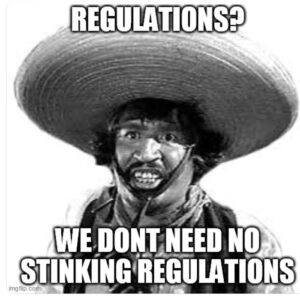
“America’s large regional banks fought and won a ferocious years-long battle across congress and several different regulatory agencies to secure exemption from Dodd-Frank rules on risk and safety specifically by arguing there was no systemic risk to normal FDIC resolution.” Greg Becker, president of SVB, lobbied Congress in 2015 to lessen the oversight on his bank!!!!!!!!!
But it caused jittery clients to withdraw large balances to avoid any losses.
Deposits up to $250,000 are protected by federal law – but anyone with larger sums tied up now faces loses their money. Dozens of customers were yesterday filmed to withdraw whatever cash they had to get out ahead of the fall-out. Meanwhile police were called to the bank’s headquarters after a group of disgruntled tech founders turned up on the doorstep.
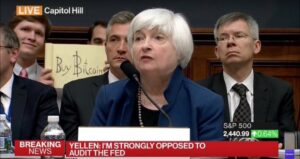 White House urges faith in regulators following SVB collapse
BUY BITCOIN PROTECT YOURSELF
“fix the money, fix the world”