 ELECTRONIC MONEY BEGINS
ONLY 21 MILLION BITCOINS
The art of story telling using videos.
Background story of how Bitcoin got here:
Friedrich Hayek (1899-1992) Political Theory
1967 Futurist Buckminster Fuller renowned “Comprehensivist” Polymath Predicts Electronic Money
1970 Nixon takes America off the gold standard.
1972 EMAIL WAS INVENTED FOR THE INTERNET
1973 CREDIT CARDS “PICK POCKET”
 1991 THE INTERNET ALLOWS CIVILIANS
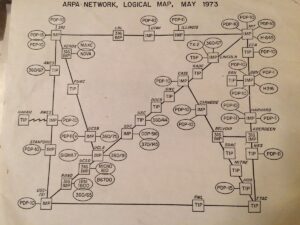
Jon Postal kept this in his desk drawer.
1994 Business is allowed to transact on the net. But no one invented money for the internet.
1999 Milton Friedman Predicts Bitcoin
Math is hard
BITCOIN FIXES MONEY
“The world of technology thrives best when individuals are left alone to be different, creative, and disobedient.” – Don Valentine
 BITCOIN BEGINS
2008 WHITE PAPER “Bitcoin: A peer-to-peer electronic payment system” by Satoshi Nakamoto.
Bitcoin was created in 2009 by an anonymous person or group of people using the pseudonym Satoshi Nakamoto. The original Bitcoin white paper outlined a decentralized digital currency based on mathematical proof.
WHAT IS BITCOIN
Peter Van Valkenburgh @valkenburgh Director of Research @CoinCenter | Board Member @ZcashFoundation | JD @NYULaw |
We broke the ruptured structure built of age.
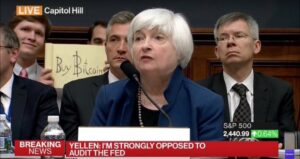
Speech at the Hearing of the US Committee on Banking, Housing, and Urban Affairs (10/11/2018)
2022 FUN FACTS
– #Bitcoin has been online for over 13 years
– 12 years ago today, 10/18/22 you could buy 10 #Bitcoin for $1
– #Bitcoin mining hashrate increased 73% year over year in Q3, 2022 Michael Saylor & Bitcoin Mining Council
– #Bitcoin is trending to 1 billion users within 3 years
K12PlayGround.com
FIND K12 Financial Literacy Projects
– YOU CAN MINE BITCOIN WITH A HAM RADIO
– You can mine #bitcoin using only a pencil and paper ✏️🗒
BITCOIN IS CYBER POWER
A little bit about energy by Jason Lowery @JasonPLowery
Space Force | MIT ’23 | US National Defense Fellow
Consider the idea that #BTC represents not just money, but also cyber firepower. That would imply its value is derived from the amount of physical power (watts) it channels into cyberspace for people to use to secure what they value.
Sats represent a receipt received for spending computational power. If you present a sat, you present proof of power. It doesn’t matter if that power was sourced from a hash farm on other side of the world, sats = real world physical power receipts = cyber power.
It should be obvious to people why transferable cyber power (proof of real world physical power) is a BIG DEAL for security. Gives people the ability to physically constrain the abstract power and control authority of people & software in, from, and through cyberspace.
You demand it. If you make an API that demands collateral sats (ie cyber power receipt) to execute sensitive control actions, u impose a real world physical cost (watts) on bad guys in cyberspace — the CURRENT cost of sats based on CURRENT hash rate, fees, block reward subsidy.
Sats aren’t money. Sats are proof of power receipts that people choose to monetize. There is a BIG difference. Sats represent a receipt received for spending computational power. If you present a sat, you present proof of power. It doesn’t matter if that power was sourced from a hash farm on other side of the world, sats = real world physical power receipts = cyber power.
It should be obvious to people why transferable cyber power (proof of real world physical power) is a BIG DEAL for security. Gives people the ability to physically constrain the abstract power and control authority of people & software in, from, and through cyberspace.
Imagine if it cost 1 sat to send a tweet. To you it would be inconsequential. To a state-sponsored bot farm it would be too cost prohibitive to run a bot/spam farm. Imagine if all programs did this. Goodbye DDoS attacks.
All cyber security incidents are derived from software control signals that weren’t sufficiently constrained. Adopt a protocol where control signals must be collateralized by #BTC and then suddenly you have a way to physically constrain control signals. This is a big deal.
Sat/Joule is the base unit. A sat is a computational opportunity cost for participating in a fair trading network. To break code needs energy, and the PoW networking protocol means a universal league of code-braking machines. The capacity to break code is the capacity to make wars shorter & that is power.
Life hack: Normalize buying #Bitcoin EVERY time you get paid.
#Internet users in 1997: 140 million
#Internet users in 2007: 3.7 billion
#Bitcoin users today 2022: 140 million
#Bitcoin took 6 months to get 1000 users;
5 years to find 1 million users.
Today, 13.8 years from inception, it has 300m+ users, 4% of the world.
At current growth rates, 1 billion users will be hit in the next 3 years. That’s 12% of the world.
FACT: @Greenpeaceusa a former grassroots organisation, took $5M from Ripple’s CEO to spread misinformation about Bitcoin
MYTH: Bitcoin is bad for the environment
REALITY: Bitcoin stabilizes grids, makes solar&wind profitable & is helping slash global methane emissions
CyberPlayGround.org+ K12PlayGround.com recommends
Trader University by Matthew Crowder
Bitcoin For Beginners 612 videos as of 10/2022
https://www.youtube.com/playlist?list=PL7w04GVKPitHIoHz9Vr0B09k7I3ljTsur
Why Bitcoin Mining Is Good For The Environment
https://www.youtube.com/watch?v=-j4cXA09Dz0
Bitcoin Lightning Network: How to Send and Receive Payments
https://www.youtube.com/watch?v=MGNvaJyZ25A
THE PICTURE OF THE EARLY IP NET ADDRESSES
WERE KEPT IN JON’S DESK DRAWER
JON POSTAL 6/8/2007
end2end-interest Digest, Vol 40, Issue 1
en**************@****el.org
Message: 1
Date: Thu, 07 Jun 2007 11:58:10 +0100
From: Bob Briscoe <rb******@**********co.uk>
Subject: [e2e] Invitation to join new unofficial IETF mailing list:
re-ECN
To: “tsvwg IETF list” <ts***@**tf.org>, “iccrg IRTF list”
<ic***@*******ac.uk>, “arch-d list” <ar******************@**tf.org>,
“DCCP IETF list” <dc**@**tf.org>, “tsv-area IETF list”
<ts******@**tf.org>, “e2e IRTF list” <en**************@****el.org>,
“eme IRTF list” <em*@**tf.org>
Message-ID: <5.*******************************@***************co.uk>
Content-Type: text/plain; charset=”us-ascii”; format=flowed
Folks,
You are invited to subscribe to a new unofficial IETF mailing list on re-ECN via <https://www1.ietf.org/mailman/listinfo/re-ecn>
Re-ECN is proposed as an extension to explicit congestion notification (ECN) intended to enable enforcement of fairness for congestion control & QoS including mitigation of DDoS and prevention of cheating between both networks & users.
Why has this list been created?:
At the last IETF in Prague, about 30-40 people got together at an unofficial BoF (Birds of a Feather) to hear about the architectural intent of re-ECN and to discuss how to move forward.
It was decided to take an ad hoc approach initially, somewhat along the lines of how HIP got started. If a community hangs together around this work, then it may form an IRTF or IETF working group.
The room was unanimous that re-ECN addresses a problem that is interesting, and about 75% were interested in using it, if it was implemented. Half a dozen people expressed interest in implementing the protocol. Full notes, transcript & slides as well as background papers are at:
<http://www.cs.ucl.ac.uk/staff/B.Briscoe/projects/refb/#Presentations>
If interested in discussion of design and implementation of the re-ECN protocol, pls subscribe via the link at the start.
———————————————–
Re-ECN is not an official working group of the IETF or IRTF. But the IETF has agreed to host the list to create a community around this work who may wish to bring it forward for standardisation. As such, if you subscribe, you will be asked to note well the normal IETF rules.
This invitation will only be sent to relevant lists once. But apologies if you are on more than one of these lists.
Cheers
Bob
Bob Briscoe, <bo*********@**.com> Networks Research Centre, BT Research
B54/77 Adastral Park,Martlesham Heath,Ipswich,IP5 3RE,UK. +44 1473 645196
——————————
______________________________
end2end-interest mailing list
en**************@****el.org
http://mailman.postel.org/mailman/listinfo/end2end-interest
End of end2end-interest Digest, Vol 40, Issue 1
***********************************************